
Here's what nobody tells you about your body
Your clitoris doesn't care about consistency. The same pattern that sends you over the edge when you're lying on your back might feel muted when you're sitting up, or too intense when you're on your side. This isn't a malfunction. It's anatomy.
The angle of your pelvis, the tension in your pelvic floor, blood flow distribution, and how much friction exists between your body and the surface beneath you all change the sensation of vibration. Add in whether you're tired, aroused, or somewhere in between, and suddenly the same lemon vibrator settings produce wildly different results depending on your position.
Why position matters more than you think
Your clitoral tissue sits at an angle. When you shift your body position, you're literally changing the relationship between the vibrator and the nerve endings you're trying to stimulate. Here's what happens.
Lying on your back (supine). This is typically the most responsive position for most people. Your pelvis is neutral, blood flows easily to your genitals, and there's minimal tension in the pelvic floor. Most people find they need less intensity here and reach sensation faster.
Sitting upright. Everything shifts. Your pelvis tilts forward, which changes the angle of approach to your clitoris. You might need higher intensity or longer warm-up time. Some people find sitting actually enhances sensation because the position naturally engages the pelvic floor, which intensifies the experience. Others find it deadens sensation completely.
On your side. Lying on one side can create asymmetrical sensation. The side you're on gets more direct access and blood flow, while the opposite side might feel distant. Some people love this because it creates focused, intense sensation on one side.
On your hands and knees or leaning forward. These positions tend to dampen sensation for most people because gravity pulls blood away from your genitals, and the pelvic floor naturally tightens. If you love sensation in this position, you're not broken. You might just be someone whose body responds to more engagement and effort.
The sensation-shift pattern most people experience
Take three minutes and map your own pattern. Here's how.
Start in whatever position feels most natural to you. Use the same lemon vibrator (clitoral vibrators like those from Lemon Vibrators work best for this test because they're consistent). Begin at intensity level 2 or 3 and notice: How quickly do you feel sensation build? How intense does it feel right now? Does it feel sharp, diffuse, concentrated, or spread out?
Now change position. Use the exact same intensity level. What changed? Most people discover they need to go up one or two levels to recreate the same sensation they just felt. Some people find they need to dial down.
Change position again. Repeat. By the third or fourth position, you'll have a rough map of your sensitivity landscape.
How to adjust your lemon vibrator for each position
Once you know your pattern, adaptation becomes simple.
If you lose sensation when you move, go up one intensity level. Don't skip levels. Jump from 3 to 4 or 4 to 5. Give yourself 30 seconds to adjust to the new intensity before deciding if you need to go higher.
If sensation becomes too intense, lower the intensity and increase the warm-up time instead. This sounds backwards, but lower intensity with longer build-up often feels better than maintaining high intensity. Your nervous system has time to engage gradually, which paradoxically produces stronger response.
If you're with a partner, communicate your position preferences before you start. Not after. Tell them: "I'm more sensitive on my back, so I might need you to dial it down when we change position." This prevents the awkward pause mid-experience where someone has to ask if something's wrong.
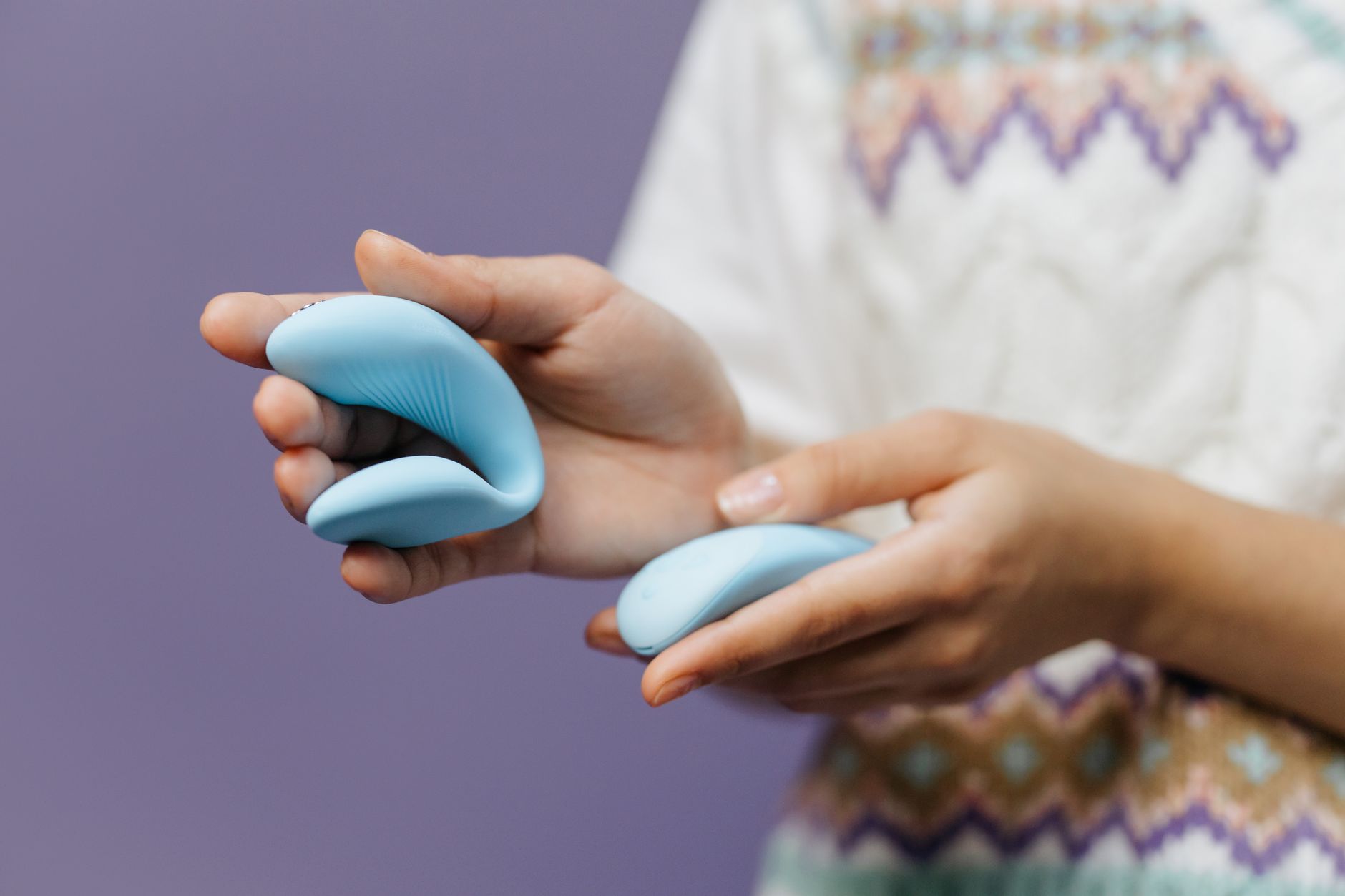
Photo by cottonbro studio on Pexels
The pelvic floor tension factor
Here's the wildcard: your pelvic floor. When certain positions naturally tighten your pelvic floor, sensation intensifies. When a position relaxes it, sensation can feel muted or distant.
Some people spend years thinking they're less responsive in specific positions when really they just need to release pelvic floor tension first. Before you change intensity, try this: take three deep breaths where you exhale into your pelvic floor. Imagine releasing and softening. Often sensation comes roaring back without needing a higher setting.
Other people find that pelvic floor tension is actually what creates their most powerful orgasms. If you're that person, positions that naturally engage your pelvic floor will feel more intense, and that's not a problem to solve. It's information.
When a partner is involved
If you're using a lemon clitoral vibrator with a partner, position changes get complicated because now there are two bodies in the equation. Your sensitivity might shift, and your partner's angle of approach and pressure changes too.
Talk about position changes before you make them. Say something like: "When we shift to this position, I usually need a bit more time to build back up." Or: "That position feels too intense for me right now." Then actually pause, adjust, and reconnect.
The biggest mistake partners make is assuming discomfort or reduced sensation means something's wrong with them or with the partner. Position is just physics. Adjust the intensity, change your angle, or try a different position entirely. That's not failure. That's information.
The equipment factor
Not all vibrators handle position changes equally. Suction vibrators like the Lemon Vibrators clitoral sucker require a certain angle and seal to work effectively. If you're changing positions frequently, you might find suction-based stimulation is harder to maintain across all positions. Vibration-based devices tend to be more position-agnostic because they deliver sensation through the vibration pattern itself, not through suction mechanics.
If you're using a vibrator that's not delivering consistent sensation across positions, that might not be a you problem. It might be a device problem.
Building a position-adaptable routine
Here's a framework that works for most people.
Start in your most responsive position. Use whatever intensity you've discovered works there. Once you're well-aroused, stay with that for one to two minutes. Your nervous system is now engaged.
Then change position. Use the same intensity for 30 seconds. Adjust up or down based on what you feel. Give yourself full permission to need a different setting.
If you're working toward orgasm, stay in positions where you know you can reach it. If you're exploring, try new positions in the middle of arousal when your nervous system is already activated. You'll need less intensity adjustment.
After you come (or after whatever your endpoint is), stick around in that position for a moment. Don't immediately pivot to something new. That moment of stillness is where your nervous system integrates the experience.
FAQ
Can my sensation preference across positions change over time?
Absolutely. Your body changes, your arousal capacity shifts, your relationship to pleasure evolves. A position that felt dead to you five years ago might feel incredible now. Check in with your body every few months instead of assuming your map is permanent. What worked last month might need adjustment this month, and that's normal.
If I'm most sensitive lying down, does that mean something's wrong with other positions?
No. You're not broken if you have a preference. Most people have one or two positions where they're most responsive, and that's completely ordinary. If you only want to use those positions, that's fine. If you want to expand your range, small intensity adjustments usually work. Forcing yourself to enjoy positions that genuinely don't work for your body is pointless.
Should I change intensity before changing position, or after I'm in the new position?
After. Get into the new position first, give yourself 20-30 seconds to settle, and then adjust intensity. If you adjust before moving, you'll change the intensity relative to a completely different body position, which defeats the whole point of the test.
What if my partner and I have completely different position preferences?
You negotiate. Maybe you start in your preferred position and shift to theirs once you're both well-aroused. Maybe you trade off. Maybe you discover that some positions work well for both of you with slight intensity adjustments. The key is actually talking about it instead of just assuming the other person's preference is weird or wrong. Like many intimate dynamics, this is worth a real conversation.
Can I train myself to feel the same sensation across all positions?
Somewhat. Consistent practice helps your nervous system get more responsive overall. Regular pelvic floor work, breathing practice, and mindfulness can improve sensation across positions. But you're never going to override the basic physics of how your body works. Some positions will always feel more responsive than others, and that's biology, not a limitation.
Is it normal for my sensation to feel stronger or weaker depending on where I am in my cycle?
Completely normal. Hormonal fluctuations affect blood flow, tissue sensitivity, and pelvic floor tension. You might find you need higher intensity mid-cycle and lower intensity just before menstruation, or the opposite. This is another reason the position map you create should be a rough guide, not a rigid rule. Check in with yourself weekly.
The takeaway
Your pleasure doesn't have to be complicated. It just has to match your body. Once you understand why sensation shifts across positions, you can stop blaming yourself for needing different settings and start using that information strategically. Position matters, intensity matters, and communication about both matters even more. If you're ready to explore how different vibrators and intensities work for you, start with your most responsive position, then branch out from there. Questions? Reach out to the team at /contact.